How SSRIs Work: The Brain Biology Behind Antidepressants
About one in eight American adults reports taking an antidepressant, and most of those prescriptions are for a single class of drugs. Selective serotonin re-uptake inhibitors, better known as SSRIs, include familiar names such as fluoxetine, sertraline and escitalopram. Fluoxetine reached US pharmacies in 1988 under the brand name Prozac, and the class has been one of the most prescribed in medicine ever since.
Despite that popularity, few of the people who take these drugs every morning could explain what happens once the pill is swallowed. The biology is a good example of how cells communicate, and of how a small change at a single junction between neurons can spread across the whole brain.
SSRIs replaced older antidepressants for a practical reason. Tricyclic drugs and monoamine oxidase inhibitors, the main options through the 1970s, worked, but they affected many systems at once and could be dangerous in overdose or when mixed with certain foods and other medicines. SSRIs were designed in the 1970s and 1980s to act on one target, which made them easier to prescribe and safer to take. Understanding that single target, and what happens around it, explains both their benefits and their limits for the millions of people who take them. For anyone asking what are SSRIs and how do they work in the brain, the answer starts with the way nerve cells pass messages to one another.
How neurons pass a message
The brain contains roughly 86 billion neurons. Each one has a cell body, branching dendrites that receive signals and a long axon that sends them on. The structure of nerve cells is built for speed.
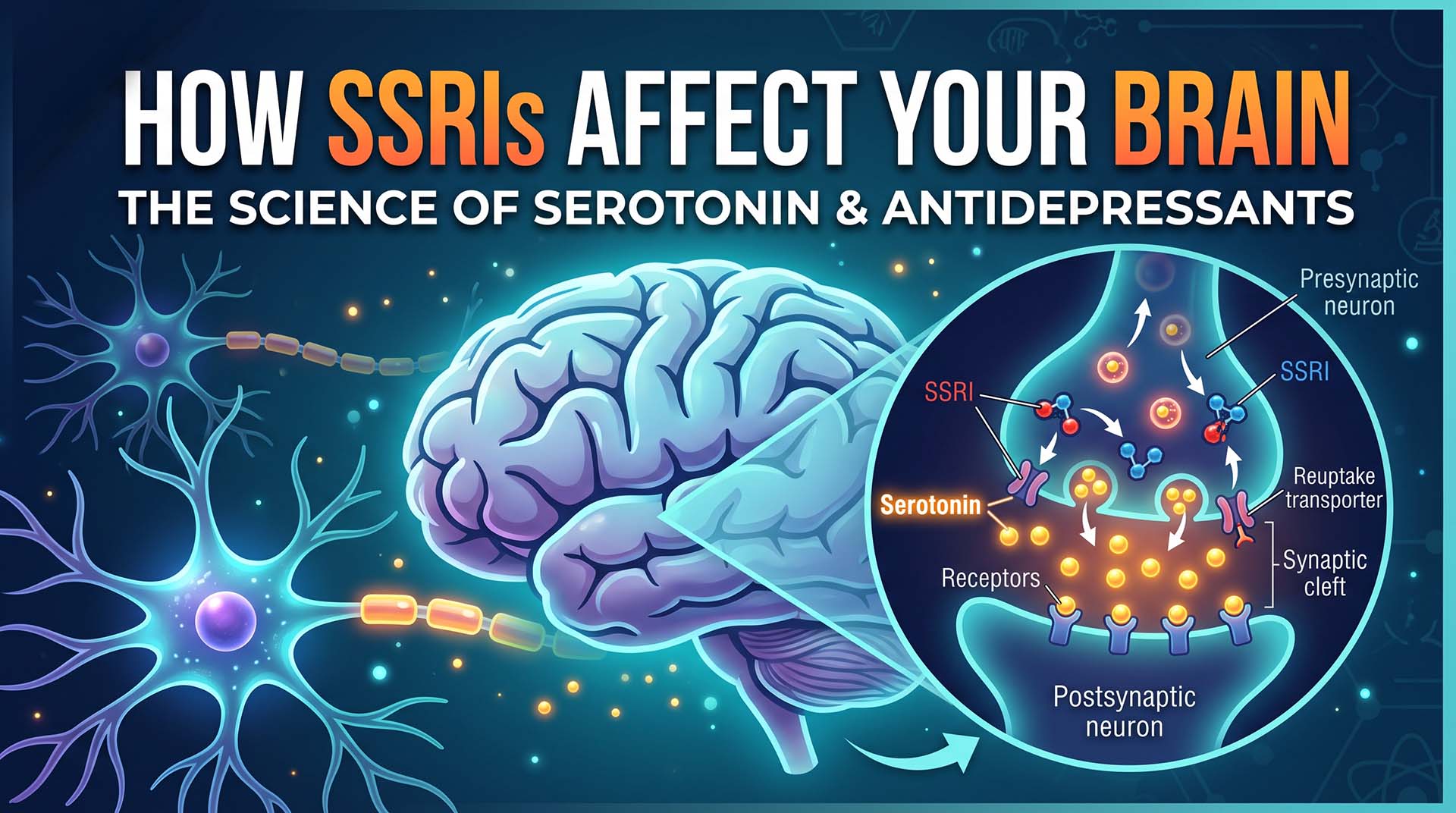
Neurons do not touch. At the end of each axon there is a tiny gap called the synapse. When an electrical signal reaches that gap, the neuron releases chemical messengers, called neurotransmitters, which cross the space and bind to receptors on the next cell. Depending on the receptor, the message either excites the next neuron or quiets it.
Then the synapse has to be cleared. Some neurotransmitter molecules are broken down by enzymes. Many are pulled back into the neuron that released them by transporter proteins, a process known as reuptake. That recycling step is what SSRIs target.
Serotonin and the re-uptake pump
Serotonin is one of dozens of neurotransmitters. The brain uses it to help regulate mood, sleep, appetite and how people respond to stress, and it works alongside other brain chemicals such as dopamine and norepinephrine. Most of the body’s serotonin, around 90 percent by common estimates, is made in the gut, but the serotonin in the brain is produced by a small cluster of neurons in the brainstem called the raphe nuclei. Their axons reach almost every part of the brain.
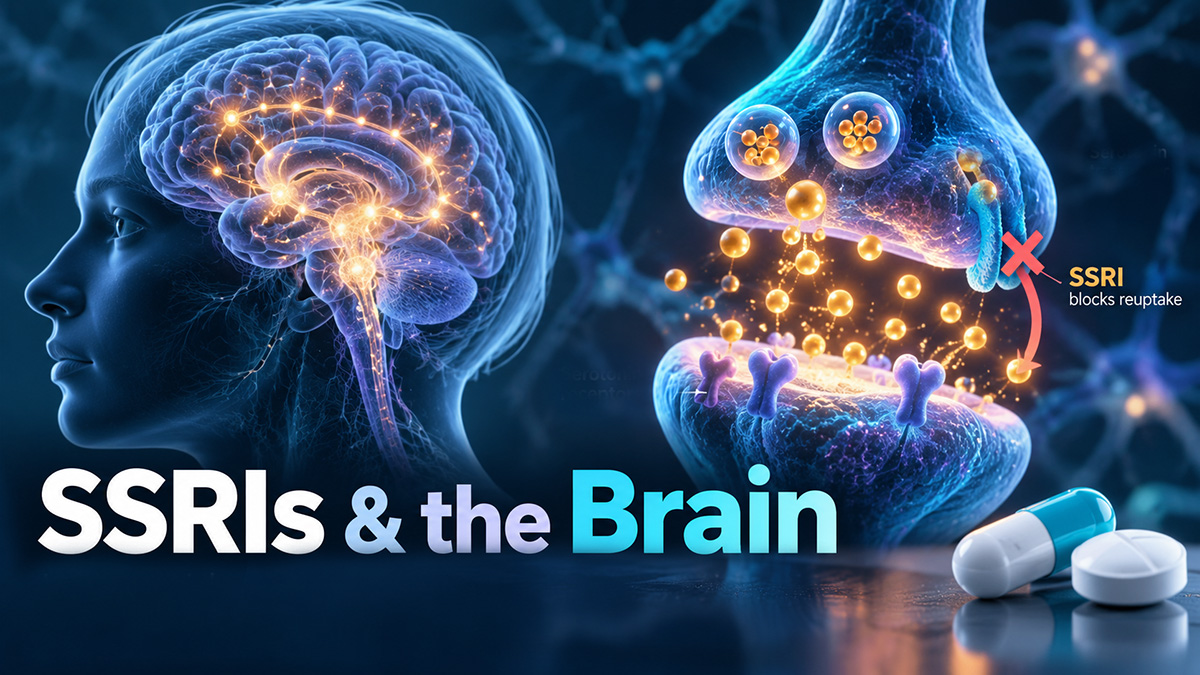
The serotonin transporter, often shortened to SERT, sits in the membrane of these neurons and pumps serotonin back in after it has been released. SSRIs bind to that transporter and block it. With the pump partly switched off, serotonin stays in the synapse longer and keeps acting on receptors. The word selective refers to the fact that these drugs act mainly on the serotonin transporter and much less on the transporters for other neurotransmitters, which is why they cause fewer side effects than older antidepressants.
Why the effect takes weeks
Here is the puzzle. An SSRI blocks the transporter within hours of the first dose, yet most people feel no change in mood for two to six weeks. If more serotonin were the whole story, the benefit should arrive almost immediately.
Researchers think the delay comes from the brain adapting to the new chemical environment. Serotonin neurons have their own sensing receptors, called autoreceptors, which act like a thermostat. When serotonin rises, they first tell the neuron to release less. Over several weeks those autoreceptors become less sensitive, and serotonin release returns to normal while the transporter stays blocked.
There is also evidence that SSRIs encourage the growth of new connections between neurons, particularly in the hippocampus, a region involved in memory and emotion. The old idea that depression is a simple chemical imbalance is now seen as too simple. A more current view is that these drugs help the brain rewire itself over time, which fits the slow timeline people experience.
Why one drug does not fit everyone
Anyone who has taken an SSRI may have noticed that the first choice does not always work. Some people feel better on the first drug they try. Others go through several before finding one that helps without side effects they cannot tolerate.
Genetics explains part of that variation. SSRIs are broken down in the liver by enzymes from the cytochrome P450 family, mainly CYP2D6 and CYP2C19. Small differences in the genes that code for these enzymes can make them work slowly, normally or very quickly. How genes are regulated and expressed shapes how much enzyme a person makes, and that in turn affects how much drug reaches the brain.
A slow metabolizer may build up high levels and more side effects. A fast metabolizer may clear the drug before it can help. The Clinical Pharmacogenetics Implementation Consortium publishes dosing guidance for several SSRIs based on these gene variants, and doctors can now order tests that report them.
What the science still does not explain
SSRIs are among the most studied drugs in the world, but important questions remain open. Researchers still do not fully understand why they help some people with depression and not others, or why they also help with obsessive-compulsive disorder and panic disorder.
Brain imaging, genetic research and studies of the gut-brain connection are all adding pieces. Some teams are testing whether blood markers or brain scans could predict who will respond to a given drug, which would save patients months of trial and error. What is clear is that a drug which blocks one small protein at one type of synapse can, given enough time, change how whole brain networks behave. For a class of medicine taken by millions of people every day, that makes SSRIs one of the most interesting examples of cell biology at work in ordinary life.