
What Does “Evenly Matched” Mean in Sports?
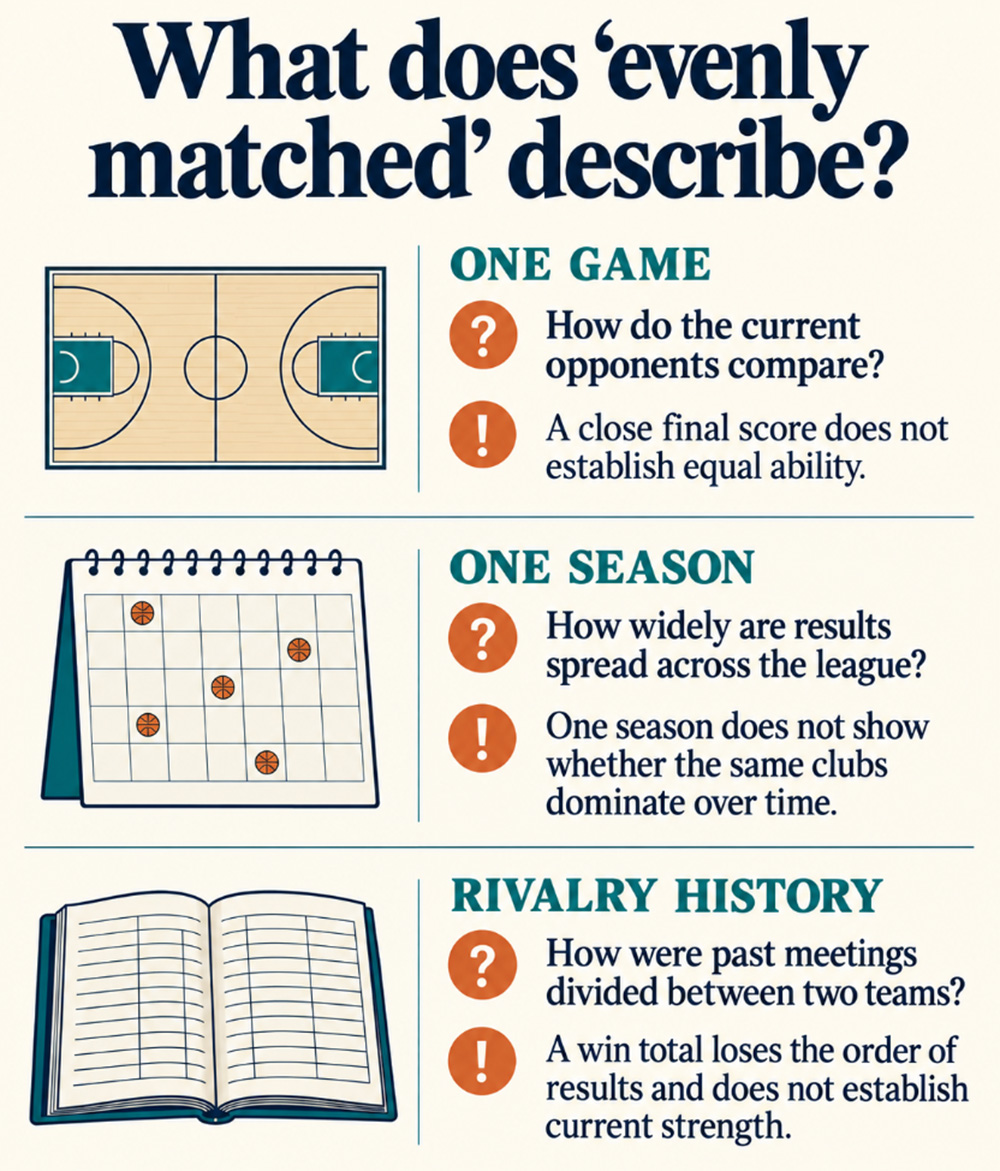
“Evenly matched” can describe teams of similar strength, a closely contested season, or a rivalry with wins shared over time. Those claims require different evidence. A close score records how one game finished; it cannot establish equal chances beforehand. A rivalry’s historical record describes past contests, while the next meeting involves current players. The time frame determines which comparison is being made.

Researchers encounter this problem when measuring entire leagues. A 2025 study of competitive balance in Saudi soccer examined how league points were distributed among clubs each season. The authors acknowledged a limitation: that measure does not reveal whether the same clubs keep dominating across seasons. A measure can answer one question accurately while leaving another unanswered.
One game asks about the present
At the game level, the question is how the opponents compare when they meet. A result records what happened once; it does not reveal every outcome that was possible beforehand. Nor does a historical series compare unchanged teams. Players and coaches move on, and results collected across different eras describe different versions of each club.
In match betting at Lucky Rebel, describing opponents as evenly matched concerns the particular game being assessed. An all-time head-to-head record covers a different question: how past meetings were divided. Using it as a description of today’s contest would assume those past games represent the teams now taking the field or court. Even a recent record needs context about the opponents faced and the period covered. A description of current strength is an estimate based on relevant evidence, rather than another name for the rivalry total.
A season changes the comparison
Across a season, attention shifts from one pairing to the distribution of results throughout a competition. Researchers can examine how widely teams’ win totals or league points differ. Equal season totals can also conceal differences in which opponents supplied those results. Here, league points mean the points awarded for match results, not the goals or baskets scored during play.
The timing of the measurement also matters. Standings partway through a season reflect the opponents already faced and the number of games completed. A final table includes the full schedule. Comparing an early table with a completed season without acknowledging that difference can make the numbers appear more informative than they are.
Research on competitive balance also distinguishes the standings’ final shape from how competition unfolds. The order of matches can affect when gaps emerge. Looking only at the finishing table loses that sequence, even though it was part of the competition that spectators followed.
A rivalry includes several kinds of history
A rivalry record narrows the comparison to repeated meetings between particular opponents. Its usefulness depends on the period included and what is counted. Regular-season results and playoff meetings describe different sets of games; neither should silently stand in for the other.
An aggregate record also loses the order of results. Counting wins tells you how many meetings each side won, but not whether success alternated regularly or was concentrated in different eras. That requires retaining the dates, not simply adding the totals.
The Sports Rivalry Index includes the Boston Celtics versus the Philadelphia 76ers and separates competitive balance, historic significance, and fan interest. Those categories concern sporting results, a rivalry’s place in the sport’s history, and public attention.
Keeping them separate makes the comparison easier to understand. Searches measure interest in a pairing, while results record competition between its teams. Historical significance concerns the wider story attached to those meetings. Combining those dimensions into a ranking does not make them interchangeable, and the ranking should not be read as a measurement of the current squads’ relative strength.
Different measures can produce different conclusions
A 2025 Champions League study reached a different conclusion from earlier research about whether the tournament’s group stage had become less balanced.
The researchers examined seasons from 2003/04 through 2023/24 under the former group-stage format. They used measures based on team-strength ratings and comparisons between expected and final group rankings. Across that full period, their chosen measures found no statistically significant long-term trend in competitive balance.
Earlier work used UEFA’s club coefficients, which count results in its club competitions. The newer study used Elo ratings, a method of updating team-strength estimates from results. These ratings include domestic matches that the UEFA coefficients leave out, so the measures draw on different evidence about the same clubs.
That finding does not establish that balance stayed identical every season. It describes the absence of a statistically clear trend across the full period under those measures. The papers covered different periods. The newer study’s authors acknowledged limitations in their indicators and did not recommend automatically replacing existing ones.
For any claim that teams are evenly matched, identify the contest or collection of contests being described. Then establish whether the evidence concerns strength before play, results after play, or performance accumulated over time. A close score, a crowded league table, and a rivalry’s historical record can each tell you something useful. They answer different questions, and none can quietly supply the answer to all three.