So you can’t really call it a garbage patch in any real sense of what we’d all imagine as a patch of garbage. In fact, it’s really more like a really remote place where you’re more than likely to see some trash floating around – in an area that you should never see trash … the middle of the pacific ocean.
Where is it?
Technically there are two patches, and eastern and western one. They’re formed by the North Pacific Gyre (which is the space in the middle of the current’s drawn). Note what else is in the middle of this gyre … Hawaii.
How big is it?
Defining the garbage patch is kind of tricky because there really aren’t a lot of people going out there to sample. Technically they are defining the region as anywhere that has more plastic than the average in the ocean. That means the entire gyre could technially have slightly more floating trash than average in the ocean. In my view, it’s not a great deffinition. But, that’s where you get claims that the “garbage patch” is twice the size of texas. Some even go as far as saying it’s twice the size of the US. Technically they would be correct. The problem is that the media jumps on these claims and overstates it. When people find out what’s really there, they start to doubt scientists, when it’s not scientists that are misleading anyone.
How much trash is there?
Don’t start thinking there is a visible patch of trash anywhere. Granted, if you were to sail through this area, you’d see a lot of floating debris (maybe 10 pieces a minute). But, most of it is tiny. You’d have to pick it up with a pair of tweezers they’re that small. The Manta Tows that the crew did pulled for an hour and a half. The images you see here are how much trash they collected in that time. It’s not as much as you’d think, given the headline, but remember, there shouldn’t be any out there.
What can we do about it?
Well, there really is no way to clean this up. It is mixed in to all the plankton in the ocean now and filtering it out would mean filtering out all the plankton too. So, that means that we’re really going to have to just think about how to stop the influx of trash into the ocean. Truth be told, I know the US let’s a lot of trash into the ocean. However, I’d be willing to say that this is a much larger problem. Just look at images you see from developing countries (I’ve taken a fair few myself). There is very little trash cleanup and thus, a LOT of their trash makes it into the ocean. That’s bad news for everyone. I say this so that you know I’m not blaming anyone here in the US. Obviously we can all do our part to use less and recycle, but even if one person every year accidentally looses track of ONE piece of trash, that’s six billion pieces of loose trash. We’re dealing with a problem of shear numbers here.
If you’re really passionate about this garbage patch, the whole effort has really been started by one guy – Charles Moore. You can read up on his mission here.
And below is a 12 minute Documentary by Lucy Marcus showing more images and science in the Pacific Gyre :
I’m a firm believer that you have to do what you love. I’m sure my colleague Jonas would agree with me here. It’s why I make science films and write profiles about plants and animals. There really isn’t a lot of money in it, but somehow we make it work. Recently, our accountant sent me this film. He said it made him think of us. As I watched it, I kind of teared up. I think you all might enjoy it as well.

As I watched this I could almost hear my brother telling me that I should get a real job (which he’s done multiple times). I remember when I was really poor, living on 1,000 dollars a month on a boat in the pacific – rent is free that way. I remember borrowing money from friends to get my cameras. I didn’t enjoy that part of it, but somehow I made it without loosing those relationships. I feel so lucky to be doing what I do. Now, I just hope that it’s useful for others as well. I hope you enjoyed this little video we found.

My name is Rob Nelson, and I’ve been interested in marine science my whole life. Fish were my world. However, sometime in college I remember thinking that I know nothing about plants. They became one of my newfound passions, leading me to film and document them for over 10 years now.
I can tell you that there are some amazing plants in this world. In the plant kingdom, most of us imagine passive green leafy-beings. I know I did. Not many of us think of them as invaders, murderers or traps. Yet, the plant kingdom contains just as many killers and oddities as one can find in the animal kingdom. In fact, I’d probably argue there are more. You see, plants can’t move, so they only defense is in the toxins they produce. While I want to profile all different types of this world’s wicked plants, I think we need to start simple. In this week’s science podcast, we’ve started by profiling the invasive plants…
My wife and I have recently teamed up with the North Carolina Arboretum to make videos for their Wicked Plants display, which included more of the world’s worst weeds. Check out the display here.
Finally, since my goal is to share some of the amazing plants of this world, I created this short list.
Top Ten Bizarre and Wicked Plants
1. The Largest Flower in the World
Rafflesia arnoldii: this parasitic plant develops the world’s largest bloom that can grow over three feet across. The flower is a fleshy color, with spots that make it look like a teenager’s acne-ridden skin. It smells bad and has a hole in the center that holds six or seven quarts of water. The plant has no leaves, stems, or roots.
2. The World’s Worst Aquatic Weed
Hydrilla:This little plant non-native aquarium plant was first introduced into Florida in 1960 and is now considered the most problematic aquatic plant in the United States. Management costs millions of dollars each year. Hydrilla’s dense mats suck out the oxygen, destroy fish populations and encourage mosquito breeding. It can sprout new plants from just small fragments containing as few as two whorls of leaves. That makes it very easy to spread. Hydrilla also prodcues turions and tubers in the soil, which can give rise to new plants after extended dormancy. In fact, one square foot plot of hydrilla can produce over 1,500 new plants!
Hydrilla is now listed by scientists as a federally noxious weed. One scientist compared it to herpes. “Once you’ve got it, you’ve got it forever.” Read more about Hydrilla.
3. A Carnivorous Flytrap.
The Venus Flytrap is native to a small region around Willmington, NC. Here, on the forest floor in the sandy soils of the pine forests, these small flytraps thrive in an area poor in nitrogen. To supplement their nutrient needs, they take insects. This helps put them ahead of the competition.
4. The Largest Single Flowering Infloresence
The Titan Arum boats the largest single, unbranched infloresence. The largest flower goes to Rafflesia, and the largest infloresence actually goes to the Tallabot Palm. But, this plant takes the prize for more than it’s size! It stinks! It’s often been called the Corpse flower, a name that doesn’t sound nearly as regal as the Titan Arum. Check out the Titan arum article we did on it after visiting a flowering one!
5. A Pot of Death
Pitcher plants grow all over the world in nitrogen rich soils. Would you be surprised to learn that they also share the habitat of the Venus fly traps? They’ve taken a different approach though. You see, they’ve actually formed into a vase, full of water to help drown their victims. While there are lots of Pitcher plants, and all of them seem to do this task slightly differently, they do share something in common. They all use animal protein to help give them an edge in their nutrient deficient habitats.
6. Corn and Vampires
You might not realize it, but if you eat a diet of nothing but corn, you may just become a vampire. Check out the video we did on it.
7. Kudzu
The Centennial Exposition, held in 1876 in Philadelphia, was a carnival of wonders. Roughly ten million Americans were introduced to the telephone, the typewriter, and a miraculous new plant from Japan: Kudzu.
Plant enthusiasts loved the flowers fruity, grapelike fragrance and the fact that the vine could scramble over a trellis so quickly and control erosion. Soon farmers realized that livestock would eat the vine, making it a good crop to feed livestock, but kudzu had other wicked plans for America. The vines made themselves at home, growing up to a foot per day during the warm summers. Over two-dozen stems can emerge from a single crown, and each of those can stretch for over one hundred feet. A single massive taproot can weigh up to four hundred pounds. Its underground rhizomes ignore the cold and survive for years before sprouting. It strangles trees, smothers meadows, undermines buildings and pulls down power lines. The vine now covers seven million acres in the US, and the damage it has caused is in the hundreds of millions. If you live in the south, you might not want to sleep with the windows open.
8. Purple Loosestrife
Do not be fooled by the stately, floral spires of purple loosestrife. This insidious weed grows from 3 feet to a towering 7 feet tall. Loosestrife takes over swiftly – a few plants dropping up to 2 million seeds per year – building a seed bank that can lay in the ground for years like a weedy trojan horse. If you drown it, the seeds can still live up to 20 months under water. Cut it up? Loose or trampled stems can produce roots and shoots, multiplying the problem. Try decreasing its light supply? Loosestrife will produce a different leaf morphology to adjust. With all these strategies in place, purple loosestrife can devastate native vegetation – overrunning thousands of acres of wetland at a time.
9. A Floating Fern – Salvinia
This free-floating aquatic fern introduced from an unregulated aquarium trade, can unbelievably double its population every two days! It forms dense mats up to three feet deep on the water’s surface. One of the largest infestations was a stunning ninety-six square miles of water surface. Giant salvinia is found in freshwater lakes, wetlands, and streams though out the southwestern US. It thrives in nutrient-rich water, so it grows particularly vigorously in water enriched by fertilizer run-off or sewer-treated plant waste. Just a tiny fragment chopped up by a boat propeller and stuck to the bottom of a vessel can spawn a who new colony in another water body. Once spread into a new lake it will take over until it has removed all of the oxygen from the water. Over 150 lakes in the US are battling Salvinia from Virginia to California.
10. Water Hyacinth – A showy floating plant.
This South American native aquatic plant is not hard to recognize. It grows to about three feet tall and sports luscious lavender blooms with a distinctive yellow spot on just one of its six petals. Although it is beautiful, the crimes that this aquatic plant has committed are so great that it should be locked away forever – if only that worked. Water hyacinth forms dense, sprawling mats on the waters surface that even boats have a hard time penetrating. Those mats become islands of their own, providing the perfect environment for other semi-aquatic plants and grasses to sprout. It is freakishly prolific, doubling its population every two weeks. Because of that its gone on a crime spree in Asia, Australia, the Americans and other parts of Africa. This plant ranks as one of the world’s worst aquatic weeds.
Other Bizarre Plants from Amy Stewart’s Wicked Plants
We’ve been inspired by this elegantly written book, and the work we did on the videos for the exhibit that we wanted to create a short list of plants, many of which we’ve filmmed already, so that you can explore some of the other deadly plants in a vicarious way.
In the past several years it has become very popular for the very, very rich multi-billionaire types to be interested in space ventures. Most of this has centered around commercial flights (Richard Branson, Virgin Galactic, Space X) for the lowly millionaires to go to space, but now a company called Planetary Resources has found several billionaires of its own to get behind their current project – Asteroid Mining.
Here’s a short video about this new, exciting project.
Where Do Asteroids Come From?
In the same Big Bang event that created Earth, the asteroids were made – of essentially the same materials. So the company plans to (over the next several decades) figure out how they can take water and mine precious metals from the NEAs – near Earth asteroids. Most of the asteroids in our solar system are in the asteroid belt between Mars and Jupiter, but there are about 9,000 NEAs – 1,500 of those are considered good prospects for asteroid mining.
What Do They Want to Mine from Asteroids?
The main things Planetary Resources is looking for are water and platinum group metals.
Water
The water will be extracted and separated into hydrogen and oxygen (the main components of rocket fuel) to create what would eventually become little space gas stations. This would solve some huge problems – since
carrying heavy fuel from Earth’s surface is one of the issues holding back deeper human space exploration. The water could also be used for the astronauts themselves – you know, since humans need water to live and all.
Platinum Group Metals
The metals they are looking for are in the platinum group – including platinum, iridium, osmium, palladium, rhodium, ruthenium. These would be dug up and sent back to Earth for use in all kinds of things. Platinum is useful in making electronics, treating cancer, in pace makers, in making spark plugs, coating wind turbine blades, making expensive jewelry, and a myriad of other things. This would be great for us because the cost of electronics could potentially be so low that all kinds of technology would be available to a lot more people.
When will they be able to mine asteroids?
The predictions for how long it will take is at least 30 years. The reason it’s going to take this long to send spacecraft to prospect and eventually extract minerals from asteroids is because the technology for this does not exist right now. This, for me, is the most exciting part of the whole thing. Spin-off products will be sure to emerge from such a challenging pursuit, and the spin-offs from every other space venture have made all of our lives better and easier in some ways. I have no doubt it is possible. Human ingenuity has made totally automated robots that work on the bottom of the ocean (totally amazing), and this is really pretty similar to that.
Who is Planetary Resources?
On April 23rd, 2012, Planetary Resources announced their plans to mine asteroids. Who are these bold individuals, you ask? The usual – a small number of very, very rich entrepreneurs. If you don’t know their names, you know who they are anyway. There are more, but the main publicized backers are listed below.
James Cameron – Director of Avatar and Titanic. He will be an advisor to the company, since he is only worth a mere $700 million.
Larry Page – Co-founder and CEO of Google. He is a billionaire backer.
Ross Perot, Jr. – Son of Ross Perot, the former presidential candidate and electronics entrepreneur. He’s a billionaire backer.
Eric Schmidt – Executive chairman of Google. He’s a billionaire backer.
Charles Simonyi – The guy who made Microsoft Office. He is a space nut who has been to the International Space Station and up to space in Russian Soyuz spacecraft.
There are a lot of smarts in this group, and I can’t wait to see how this all plays out.
Visualize it Better…
Space.com opened this image up to us. We think it portrays the scenario pretty well
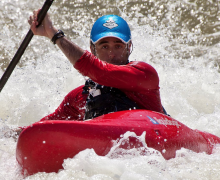
On a typically chilly day, a kayaking race begins every year on the first Saturday in November at high noon. Hundreds of fans come out to the race to watch what has been called the most extreme kayaking race in the world. We wanted to check it out for ourselves and see what all the hype was about.
We camped out the night before to get a good spot on the cliffs overlooking the gorilla, the largest, and craziest looking drop of the course. For 4 hours, we watched racers go by. While most took it cleanly, there were a few that couldn’t pull the boat around to hit the fall cleanly. Check out this video of some of the carnage at the Gorilla!
What it takes to win
Winning a race like this means you’re an awesome kayaker. Yet, more than that you need experience on this course. Almost every person who places in a race like this is from the area. Locals are at a clear advantage because they know what lines to run. It almost becomes muscle memory after awhile. The race is an extremely fast race though. The winning times are under 5 minutes. Here are this year’s results.
Where is the Green River
The green river is located just southeast of Asheville. The river is damn fed, so it runs a good portion of the year. In fact, because of this and some of the other local rivers, there are a ton of kayaking manufacturers in the area.
Why is it that some objects float and others don’t? The truth is, it’s because of buoyancy. Here is the second video in our “science of the Olympics” series.
What is Buoyancy?
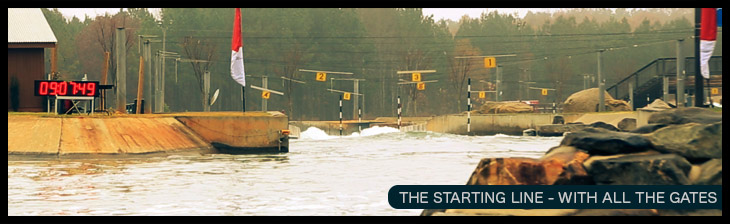
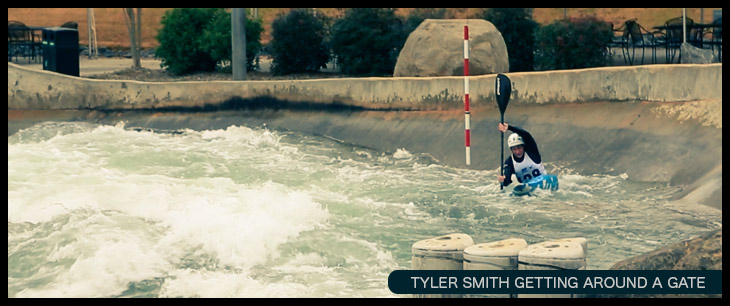
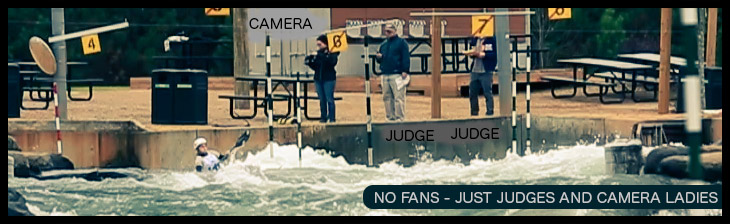
In physics, buoyancy is described as a force exerted by a liquid, gas, or other fluid that opposes an object’s weight. For kayakers, we usually discuss buoyancy relative to a kayak sitting in the water. So to understand buoyant force, we decided to go to the US National Whitewater Facility in Charlotte, NC.
In flat water, a kayaker and his/her boat are being pulled downward via gravity, and a buoyant force is pushing upward.
In simple terms the buoyant force is equal to the weight of the water the kayaker displaces. That seems pretty simple right? A 50kg kayaker and boat would displace 50kg of water. A 80kg kayaker and boat would displace 80kg of water. That way the forces are always equal and the kayaker doesn’t go anywhere.
In the Olympics, slalom kayakers have to go around gates. To change direction quickly, a kayaker can use bouyancy. You see, when they spin around a corner, they whip around the stern of the kayak. The energy of the change in velocity drives the stern of the boat underwater. The force is big which drives it down. It keeps going until the bouyant force slows it down. There is much more water displaced than the kayaker weighs. Since the bouyant force is now much greater than that of gravity, it rockets the kayaker out of the water. Because of the shape of the boat they can direct the force in the direction they want to go instead of just up. Here is a picture of Pablo McCandless mid-turn.
Maybe an easier way to look at this is with a trick kayak. Here Sam Fulbright balances the kayak on its nose. Notice how unequal the forces are at the bottom of his bounce (see picture below). Eventually it gets so great the kayaker can do a flip. How awesome is that!
Buoyancy Math Problem
Here is a fun little problem for you. Just as we highlighted at the end of the video, how would you calculate the force needed to sink the raft given the following…
Learn more about Olympic Slalom Kayaking / Canoeing
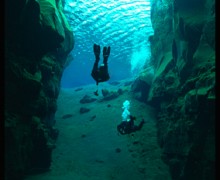
Ever wondered why the ocean is actually blue? In reality, there are many different explanations that in combination help explain the reason the ocean is blue. To help you understand the theory we’ve created an amazing little short. The video deals with the reflections of light, and so we begin with a short intro in Chicago at the famous bean statue! From there we head to Honduras, for a diving adventure to the bottom of the ocean
Untamed Science Feature: Why is the Ocean Blue?
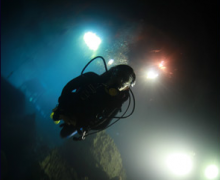
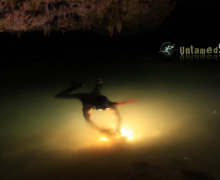
Now that you’ve seen the video, do you understand better? It has everything to do with the way light is reflected and absorbed by water. Remember, light is made of different wavelengths of light. We perceive these wavelengths as colors. Water absorbs the different wavelengths at different intensities. Essentially, red is the first to get absorbed, and blue and green the last. That’s why pictures of scuba divers at depth appear to have grey-blue skin! There is no more red in the water for the camera to pick up.
More Sources Explaining – Why the Ocean appears Blue
Lyme disease is an infectious disease casused by a species of bacteria in the genus Borrelia. The main species is Borrelia bourgdorferi, although there are a couple of other species emerging in other parts of the world. The parasite affects the joints, heart and central nervous system. Fortunately, a dose of antibiotics can cure the problem. The parasite is passed by ticks from infected hosts to humans.
The Ecology of Lyme disese
Lyme disease as an infectious disease, highlights just how important it is to study the ecology of the environment we live in. You see, the problematic parasite needs many things to fall into place for it to encounter a human host. They need ticks, hosts and reservoirs.
A tick isn’t born with the spirochaete. It picks it up in the process of taking blood meals throughout it’s life. Brian described the ecology as looking something like this:
Where is Lyme disease found
While you can find lyme disease all across the United States, the major hotspots, as indicated by this US incident map from 2010, are the northeast and the Wisconsin and Minnesota areas. If you have lyme symptoms in some of the other areas, it is likely you may have another tick carried pathogen. Ultimately they are all treated the same way though, so make sure you get your antibiotics.
Treatments for Lyme disease
Lyme disease is generally treated by antiobiotics. The most common antibiotic used is doxycycline. If you think you have lyme disease, get to your doctor right away. If left untreated, lyme diseases can cause a chronic illness. If you really want to be scare someone into going to the doctor for treatment, watch this documentary.
More of Brian Allan’s Research
Allan, B.F., H.P. Dutra, L.S. Goessling, K. Barnett, J.M. Chase, R.J. Marquis, G.C. Pang, G.A. Storch, R.E. Thach and J.L. Orrock. 2010. Invasive honeysuckle eradication reduces tick-borne disease risk by altering host dynamics. Proceedings of the National Academy of Sciences 107(43): 18523-18527.
Allan, B.F., L.S. Goessling, G.A. Storch and R.E. Thach. 2010. Blood meal analysis to identify reservoir hosts for Amblyomma americanum ticks. Emerging Infectious Diseases 16(3): 433-440.
Allan, B.F., R.B. Langerhans, W.A. Ryberg, W.J. Landesman, N.W. Griffin, R.S. Katz, B.J. Oberle, M. Schutzenhofer, K.N. Smyth, A. de St. Maurice, L. Clark, K.R. Crooks, D. Hernandez, R.G. McLean, R.S. Ostfeld and J.M. Chase. 2009. Ecological correlates of risk and incidence of West Nile Virus in the United States. Oecologia 158: 699-708.
Allan, B.F. 2009. Influence of prescribed burns on the abundance of Amblyomma americanum (Acari: Ixodidae) in the Missouri Ozarks. Journal of Medical Entomology 46(5): 1030-1036.
Allan, B.F., F. Keesing and R.S. Ostfeld. 2003. The effect of forest fragmentation on Lyme disease risk. Conservation Biology 17: 267-272.
In this video we give a sneak peek into one of our new elementary videos produced with Pearson Publishing for their new elementary science series. Learn more about this series and other science videos that we have done with Pearson here.
Gravity Defined
Gravitation, or gravity, is a natural phenomenon in which objects with mass attract one another. In everyday life, gravitation is most familiar as the agent that gives weight to objects with mass and causes them to fall to the ground when dropped. Gravitation causes dispersed matter to coalesce, thus accounting for the existence of Earth, the Sun, and most of the macroscopic objects in the universe. Gravitation is responsible for keeping Earth and the other planets in their orbits around the Sun; for keeping the Moon in its orbit around Earth; for the formation of tides; for natural convection, by which fluid flow occurs under the influence of a density gradient and gravity; for heating the interiors of forming stars and planets to very high temperatures; and for various other phenomena observed on Earth.
Will Pesek Profile – Professional Skydiver
Will is a professional skydiver for SDC Standard out of Skydive Chicago. Besides being one of the most amazing skydivers we know, he’s also a cool guy. We had to make this short profile video for Will so that you could see his personality a bit more.
Salamander diet changes with age. Young salamanders will often eat small daphnia or cyclopsen (small microorganisms in pond water). After a few weeks they will eat larger daphnia. A few weeks later they’ll eat tubiflex worms or mosquito larvae. When they are almost two months old they’ll eat the same food as an adult salamander.
The easiest food to find to feed captive larval salamander or neotonic salamanders (those that remain aquatic) are brine shrimp and black worms. Cut up the black worms for the very small salamanders as it is difficult to feed them whole worms. When they get bigger introduce the tubiflex worms, earthworms, small fish, ghost shrimp, crayfish and other small animals.
Typical Adult Salamander Diet:
Adult Salamanders are extremely carnivorous, eating almost anything that moves. They’ll readily eat maggots, mysis, springtails, buffalo worms, fruit-flies, or crickets. I will often offer them red mosquito larvae on a wet tissue.
Tiger Salamander juveniles will take aquatic invertebrates such as daphnia and brine shrimp, insects, small fish, and worms.
The adults can be fed a selection of feeder insects such as crickets, earthworms, wax worms, a selection of wild caught insects (be sure the area collected from is not sprayed with pesticides) and can be offered the occasional pinkie mouse. Make sure these salamander are not in the tank with smaller salamanders because they may end up as part of their diet as well.
Chinese Fire-bellied Newt Diet
Chinese fire-bellied newts should be fed both animal and plant food items. Bloodworms work well as a primary food item. They will also feed on guppies, earthworms, brine shrimp and even freeze-dried tubiflex worms. Feeding these newts three times weekly should suffice.