How the Internet Helps Preserve Endangered Animals

We live in a world that is home to many wonderful species. Sadly, it’s also a world where many of these amazing creatures are critically endangered, and some even extinct. The Mountain Gorilla and Orang-utan – two of the magnificent Great Apes – are now present in tragically small numbers thanks mainly to man’s devastation of their natural environments for his own use. Of the majestic big cats the Tiger is remarkably close to extinction in the wild and others are also endangered, and the Black Rhinoceros is near extinct too.

How does the internet help? First, it gives us access to more information and resources than we could ever imagined. A simple search brings us a list of the animals that are on the critically endangered list, and we can then choose to donate to a charity should we wish. Yet there are further ways in which the internet helps in our fight to keep the endangered species alive.

Paperless Commerce and Online Retail

One of the major benefits of the internet and its use in commerce and retail has been a direct effect on recycling and the reduction in use of plastics. With a paperless office, for example, we reduce the number of trees cut down to make paper. An online retail store is a largely paperless enterprise. Online retail not only cuts down on the use of paper, but also on pollution, with the only necessary vehicle being the delivery.

Where plastic is concerned, it’s important to look at the seas and oceans, and the astonishing pollution by non-biodegradable plastics that are in the water. Each year, around 150million tons of plastic us produced for use in single-use items. Plastic carrier bags, cups, straws and more are among the most common. Each year, some 8 million tons of plastic – largely single-use items – ends up in the oceans and seas of the world.
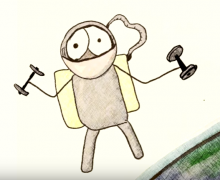
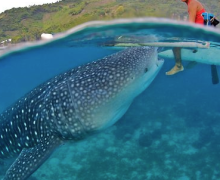
What problems does this cause? Let’s talk about whales. Wonderful, often massive creatures that they are, many species of whale are in decline. The reasons are unrestricted hunting in some parts of the world, and pollution by plastics and other items that may get into the digestive system. Thanks to this pollution, many whales find their natural food – smaller fish and other sea creatures – more difficult to find as their populations decrease. It’s a vicious circle that is difficult to stop.

We can do our bit by moving to paperless office work – cloud storage has made this much easier – by utilizing online retail, and by not using single-use plastic items.

How Online Entertainment Helps

The Yangtze river, 6300km in length, was once home to the Yangtze River Dolphin, which was common in this magnificent waterway. The last example was spotted in 1994 and, in 2006, a team scoured the length of the river without finding a single specimen. The Yangtze River Dolphin has been declared extinct. It joins other animals such as the West African Black Rhino, the beautiful Formosan Clouded Leopard and many others that no longer exist in the wild.


You may be wondering why, after reading such a tragic paragraph, we are about to talk about online entertainment? The simple fact is that life goes on, and among all the hard work and sad news, we need to enjoy ourselves. The internet helps greatly in this as we can read, keep up with friends and family, and – best of all – play games and visit online casinos.

Conclusion

In the above we have shown how the internet is helping with the preservation of endangered species in ways you may not have considered. The more we use online retail, e-commerce and less in the way of paper and plastics, the more we can help keep our wonderful wildlife out of danger. 

5 Facts About the Arapaima

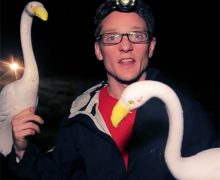
The arapaima or pirarucu is the largest freshwater fish in the world. Here are a few facts that you might not have known about this massive amazon fish. As always, we start each article with the video we made about it:

The Arapaima Facts Background

I spent two summers in the amazon looking for wildlife. I had hopes of seeing a wild arapaima but every time we went out to find one, all we’d ever come back with were Piranha. And as a side note, that’s why I wrote the article about how to survive a piranha attack. In the end I had to go to the Universeum on Gothenburg Sweden to actually see some of the arapaima in their massive freshwater tank.

So, let’s get to a few of the more fun facts about the largest freshwater fish.

1 – Arapaima breath air

These fish live in the murky waters of the amazon and have a modified swim bladder that serves as a type of lung. This means they swallow air from the surface and then use that to absorb the oxygen with. They can use their gills, but not much.

2 – Arapaima are among the largest freshwater fish in the world

The arapaima can grow up to 15′ long and weigh up to 440 lbs. Because of that is considered by most people to be among the largest fish along with the beluga sturgeon, mekong giant catfish, giant freshwater stingray and alligator gar. In some ways, it depends how you measure “largest” but these are some of the biggest in the world.

3 – They are Mouth brooders

There are a bunch of other fish that are mouth brooders – meaning they take in the young and protect them in their mouth until the fish get a bit older.

4 – Arapaima have gastrointestinal tracks that are opposite every other fish

This is an odd science fact but most fish have gastrointestinal tracks that go to the left of the stomach. In some ways, that’s just weird because every other fish that’s not an osteoglossiform fish, have intestines that go to the right of the stomach.

5 – Arapaima are going extinct

Extremely sad, but the arapaima is going extinct. According to this study, they are already extinct in 19 percent of their range and unless people limit their fishing of these massive fish, their continued existence is questionable.

Want to learn more:

Subscribe to my new StoneAgeMan Youtube Series here, or check out the new StoneAgeMan Survival Courses.

We Wrote a Wildlife and Bushcraft Survival Guide!

What do you do if see a black bear in the woods? Do you climb a tree or play dead? Is your response different if it’s a grizzly bear attack? What about surviving a wild boar attack or a cougar? We answer all these questions in our new book – Mother Nature is Not Trying to Kill You.

Why We Wrote this Wildlife Guide Book

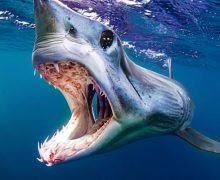
The movie poster of Jaws depicts a girl swimming at the surface of the ocean, with a great white shark lurking below. Talk about a terrible image to take with you every time you step foot into the water! 

As a kid, it was forever burned into my mind. Even in the pool, I imagined the sharks coming from the vents! I had a  recurring nightmare about it. Fortunately, I learned that Jaws was a fictional story. I was told a counter-story – sharks don’t eat people. 

Now a marine biologist, I still want to tell myself that sharks don’t eat people, but the fact of the matter is that… well, sometimes they do. But it doesn’t mean we all have to be helpless floating meat-balls. 

If you know a little bit about the behavior of many of the potentially dangerous things that live in our world, maybe you’ll be less scared of exploring on your own. Maybe you’ll be safer. Maybe that will make you the master of your domain. Who knows! Maybe your knowledge will grow into an admiration and love that leads to protecting the wild places that harbor those amazing creatures. 

Here is what this book isn’t

This isn’t a book about how scary and terrifying all these animals are. That does nothing but scare you with the sensational. I won’t take the opposite approach either and say that we humans are evil doers in every wildlife incident. It’s not about sharks being victims. It isn’t a book suggesting crocodiles might be harmless and misunderstood. 

Instead, let’s first view nature in a very pragmatic way. What are ways we humans can get into trouble? What are the lessons we can learn from tragic mistakes of the past? What does science say about the behaviors in question? And how can you apply this knowledge so you can feel confident in our wild world?

I hope what you learn here helps clear the way to turn your fears into a love affair with what some would consider the scary part of nature. The scary can give way to awe for exactly what these creatures are – even if what they are are giant man-eaters. 

Armed with a new perspective based on science and real life examples, I bet you will look at animal encounters in a new light. When you watch movies, you might find yourself looking at scenes from movies with a more discerning eye. Think of  JAWS again- where the marine biologists end up getting eaten by the over-sensationalized shark villain. Then contrast that with the modern insta-models and shark activists that swim alongside these massive sharks hoping to make you think they’re only gentle giants. The truth is not one or the other. It is in the middle. You can take these facts, make up your own mind, and judge your own risk. 

Here is what this book is

This book is designed as a straightforward guide book – a “what happens if?” book for encountering wildlife with a mix of true stories and relevant biology. I’ll walk you through many animals that have the potential to kill you, with a heavy emphasis on how to avoid an encounter in the first place. The sections on deadly plants and fungi could fill entire guides on their own, but I’ll  take you through the basics of each and best practices for staying safe when encountering them. 

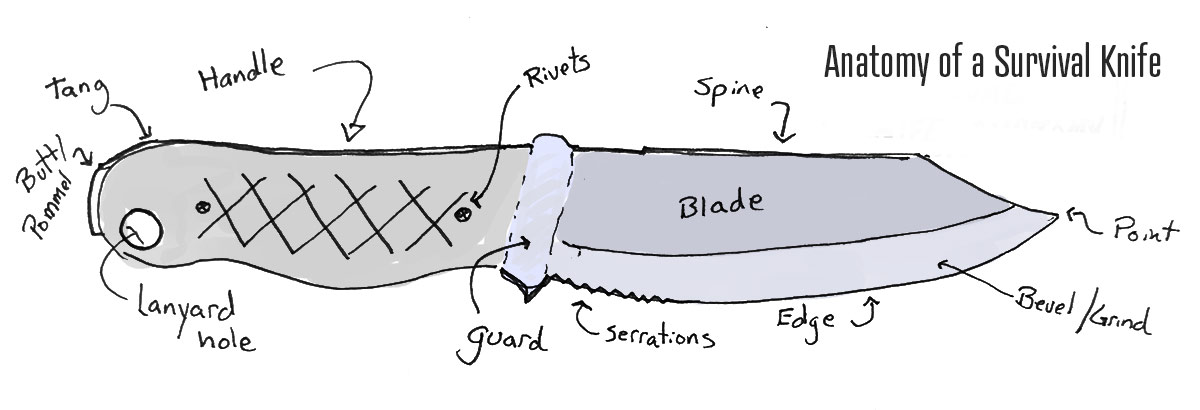
The last section gives the basics of outdoor survival. This includes knots, knives, fire-starting and the shelter building. It’s often these basics that (with a little practice and knowhow) could really save your life. 

You can find even more outdoor survival resources and videos through my YouTube channels and via StoneAgeMan.com and UntamedScience.

An Audio Sample: My Survival Story

I did record the audible version of Mother Nature is Not Trying to Kill you too. Here is a sample from chapter one.

Buy the book!

You can get the Wildlife and Bushcraft guide on Amazon.

If you’d rather support the work we are doing I have signed copies for just a tad under what you can get it on amazon here. If you don’t want to support us at that tier for long, you don’t have to. It’s great to have you here though. Just drop your monthly support to whatever you’re comfortable with. 🙂

I hope you enjoy the read! If you pick it up, let us know what you think!

The Basic Science of Online Casino Games

As online gaming has grown in popularity, an important subsection of this market, online casino, has mirrored these trends and has grown leaps and bounds in the last few years, Driven predominantly by advances in technology, developers have also taken advantage of changing player habits too offer on the go gaming, accessible all day, every day from the comfort of the players own home. Technology has become more affordable, and the advent of the smartphone, allowing for internet connectivity of the go has allowed for mobile casino gaming to grow.

Players have the ability to access the online casinos, and developers are able to optimize their offerings to the mobile market, as well as using technology to make game play fresh and exciting, as well as attract and engage players. The current online market is estimated to be worth upwards of US$60 billion worldwide and is expected to reach in excess of US$90 billion by 2023.

The most popular games in an online casino have been recreated faithfully thanks to skilled utilization of scientific methods and psychology. But how have they done this exactly?

Slots

Online slots are perhaps the most popular online casinos game of all. They are quick, fun and engaging. Simple to play, there are no rules to learn and a complete novice can play almost immediately. However, this simplicity belies the complex technology behind it. In order to make it fun and exciting, and to offer so many different themes, lines and reels, developers have to work hard to deliver true randomness and appealing visuals and sounds.

Random number generator

The Random Number Generator (RNG) is critical for fair gaming

. The RGN uses an algorithm created by a computer that generates a sequence of numbers that link to a specific symbol on the reel and cannot be worked out or reproduced. The RGN weights different symbols differently, so lower symbols are more heavily weighted meaning players are more likely to get lower symbols with smaller wins. All reputable casinos get their RGNs verified independently on a regular basis to ensure fairness, and so their players know they are being treated fairly.

Return to Player Value

The Return to Player Value (RTP) is a mathematical statistic that shows how much, theoretically, the game will pay out. Expressed as a percentage, the higher the number the better for the player. For example, a game at 97.2% RTP will pay out US$97.2 for every US$100 paid in. This however does not specify over what time period the game will pay out, as this will link to the RGN.

Psychology

Although slots are a game of pure chance, there is still an element of psychology behind it to keep players betting. Many studies have been completed around human behavior, conditioning and gratification, showing that there are many tricks that casinos use to keep people at the slot machine, be it in a land casino or online. 

Music: this plays an important part, as it needs to be engaging but also appealing to greatest number of people to keep them playing. High energy music helps keep players pressing the button, chasing the high of winning. There are also shifts from major to minor keys to increase the anticipation, and there is usually a fun sound that signifies the player has won.

Button: although the player actually has no control over what happens, giving them the power to press the button on the screen keeps them engaged and means they are involved and more likely to keep going. 

Near misses: these encourage ongoing play as players want to rectify this.

Low bets: when wagers are mere pennies, players don’t think twice about playing another bet, and this soon adds up and is a valuable source of income for casinos.

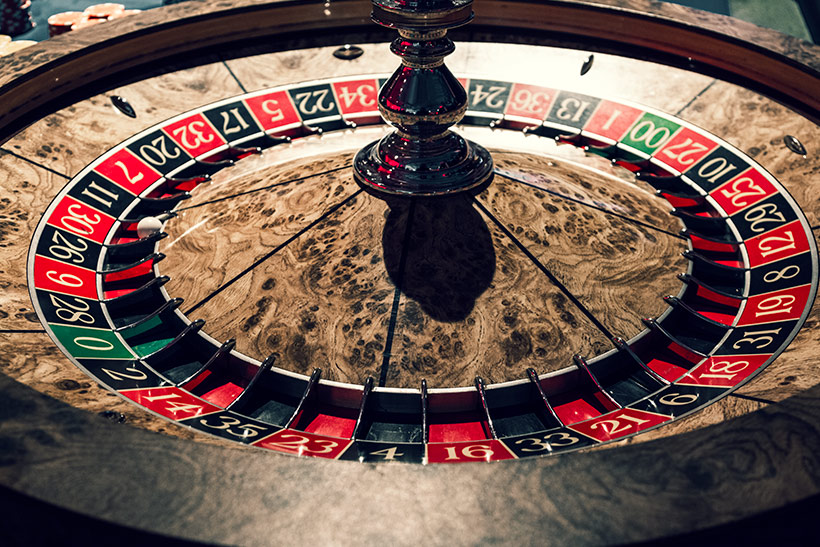
Other games also use a similar scientific basis to be successful, including roulette, which uses the RGN when spinning the roulette wheel to ensure fairness, as well as other mathematical formulae to calculate odds. The flashing lights and sounds help to engage players and keep them coming back.

Poker

Whilst there is a variation on the RGN to ensure that when the cards are dealt it is as if they have been fully shuffled and dealt out randomly, much of the science behind poker, a game of skill, is around the psychology of the game.

  • Player self-knowledge: Players must understand their own motivation and control their emotions. Players who are not natural risk takers will play differently to those who are more daring.
  • Confidence, not ego: Although online, how they bet, and the size of bets can demonstrate how confident someone is. 
  • Focus: Keeping a strong focus of knowing how previous games have played out, how people bet and remember (roughly) what cards have been before.
  • Avoiding ‘tilt’: This is frustration at a run of bad hands/difficult opponents/bad luck, and can lead to rash decisions and mistakes. Players should refer back to focus and emotional resilience to keep this in check.
  • Trust the odds: The maths does not lie. Players should use this to their advantage to ensure they maximize their chances of winning.

There is a great deal of science and technology behind the successes of online casinos, ensuring fairness and engagement. Online casinos will use anything they can to engage and retain players, and will continue to use technology are is develops to bring more excitement to their offerings.

The Relationship Between AI and Poker

What is Artificial intelligence?

Artificial Intelligence is used to help computers complete tasks usually carried out by humans. From simple programs through to computers that can learn and think for themselves, AI is a new and upcoming area of research that is being used to revolutionize the world of security, transport, medicine, and gaming to name a few.

AI in gaming

AI has traditionally been used in two-player, zero sum games (i.e. where what one player loses, the other player wins) such as Go, Chess, and Checkers. Each of the AI programs designed for these games was attempting to reach some sort of approximation to the Nash Equilibrium and are based on elements of game theory. 

Games where AI has been successful tend to be ones where there is perfect information: for example, on a chess board, both players can see all pieces and identify what steps they and their opponent can take next. There may be a surprise move from an opponent, but it must be a legal move thus limiting the element of uncertainty, and AI has used this to its advantage.

What are the unique challenges with poker?

Poker is a game of imperfect information; the other players do not know what their opponents are working with and requires an element of intuition from players to guess what cards their opponent is holding in their hand. Often AI will run algorithms to calculate all possible results of a game, and in doing so can lead to strategies that don’t work for the game emerging. One of the two programs that have finally managed to beat a human poker player is DeepStack, and one of the key elements to their success has been to only have the AI calculate a few steps ahead, and recalculate data as new information in introduced to the game. The development of ‘neural networks’ created by the machine-led learning has helped the program limit the number of potential situations by learning and being able to adapt to the behavior in the game. It is estimated that training DeepStack’s neural network required the program to solve over 10 million randomly generated poker game situations.

Poker is also a game traditionally played with more than two people, and the bots have had to learn the rules of poker to be able to compete against real people.  

Artificial Intelligence Programmes in Poker

Pluribus

Pluribus was designed to play against copies of itself without any data or prior human input. It started playing from scratch and using counterfactual regret minimization as it played. This then became an iterative process and as it played it was learning and storing information on different strategies that could be used. By assessing what strategies worked, and which didn’t it was able to improve the longer it played, improving the outcomes exponentially. When pitted against real poker players, Pluribus used its stored data as a blueprint to start the game, and then the inbuilt learning software to learn from its opponent to improve its strategy. Pluribus was able to beat players (poker champions at that!) in a six-player game, not just one on one, in part due to the ability to learn and adjust and use different strategies throughout the games.

DeepStack

Deepstack was recently tested against 33 professional poker players over the course of 4 weeks, playing almost 45 thousand games of no-limit, two player, Texas Hold’em. After removing instances of winning through pure luck, researchers were able to compute that the AI had a final win rate of 486 mili-big-blinds per game, around ten times what is considered a good rate by a competent professional poker player. One of the ways it managed to do this was by having technology built in that allowed for the probabilities and strategies to be recalculated throughout the game whenever there was the introduction of new information, be it a new card of a new bet. DeepStack also has deep learning, software to help it learn as it plays.

Libratus

Designed by researchers at Carnegie Mellon, Libratus took part in a 20-day poker competition where it was able to beat four top ranking human poker players over the course of 120,000 hands. Unlike DeepStack, Libratus requires a lot more computing power for its algorithms as it does not have any kind of learning software, so it does not improve over time.

Could AI change poker?

Whilst there have definitely been huge strides in AI as technology has improved, there is a still a long way to go for these bots to take over poker games, or even really influence the game as it stands. Even in chess, where AI has been under development for years, it is only recently that programs have been designed that can beat humans, and even then, the human element of game play is still hugely important for competitors. In terms of things like bluffing, and tells, these remain hugely important in poker, and someone is a good player not just because of their hands, but due to the way they play, when they fold, the size of their bets and showing human emotion. Much of poker is rooted in psychology and socialization, aspects of the game that the bots have yet to master. AI however, can be used to help players learn different strategies and improve their poker games without risking real money.

Science Behind Online Slots

Online slots are, by far, the most popular type of game in online gaming venues. Ask any casino player, and they will tell you that playing slots is a regular part of their gaming routine for various reasons, such as HD graphics and high-paying symbols. 

However, after completing several studies on slots UK, online gaming experts discovered that these superficial characteristics are not the only reasons players have remained enchanted by online slots for such a long time. Read on to find out what science has to do with the seductive powers of slot games.

Why Are Slots So Popular?

If you don’t think that online slots are the most popular game in online casinos, just visit the first one you come across. For example, take a look at the number of online slot machines on Mega Casino UK, and you’ll quickly realize there are a lot more of them compared to any other game on the platform.

As online slots have dominated the online gaming industry for years now, some experts decided to find out exactly which characteristics of slots make them so popular. Here are three reasons that emerged from the research.

Simple Gameplay

Online slots are probably the most straightforward game you can plan in an online casino. There are no complicated rules you need to remember, and there are no particular skills you have to develop either. The only thing you should be able to do is locate that Spin button, and you’re good to go.

Attractive Design

With their high-definition graphics and eye-catching design, online slots are tough to resist. Furthermore, these games are usually inspired by themes familiar to the whole world, such as ancient civilizations or popular movies. Sometimes, players open a particular slot out of curiosity but remain tied to their screen for hours. What is more, thanks to amazing graphics, even free slot games can keep you occupied for a while.

Easy Money

You’ll hardly meet a person these days that wouldn’t like to earn some cash without too much effort. Well, according to some players, online slots can make your wish come true. Your only job is to enjoy the audio-visual aspects of the game and click a single button, and if you’re lucky enough, the money will flow to your account. It doesn’t get any easier than that!

However, it’s one thing to find a game appealing initially, but staying on it for several hours is entirely different. In other words, attractive graphics and relatable themes are not enough to keep you engaged in such a simple game. 

For this reason, we decided to dive deeper into the waters of online slots and find out what it is that makes slot games so captivating.

Psychological Aspect

After years of studying the background of online slots, many studies have concluded that there’s more to this game than pure visual effects. B.F. Skinner came up with a set of psychological principles in the 1960s that can be recognized in the operation of slot machines.

He named the philosophy Radical Behaviorism and claimed that all human action was a direct consequence of conditioning. To prove this theory, Skinner carried out an experiment in which he used pigeons. Namely, pigeons were trained to press a lever to get rewards in the form of food.

After some time, the food stopped being distributed on every press of the lever, and it turned out that pigeons started pressing it more often. If you recall how slot machines work, you can quickly notice that humans behave the same way.

Furthermore, the sound effects that slots produce also affect players. Once you hear the sound of coins, your brain immediately imagines real-money rewards and gives out an order to spin those reels more.

Finally, the fact that you immediately know whether or not you’re a winner is what provides the greatest satisfaction. Once you feel the taste of victory, you won’t be willing to give it up anytime soon.

10 Essential Steps You Should Take To Boost Your Photography Business

There’s a common misconception that owning a photography business is as simple as having a good camera. While a camera is a good start, it requires more effort to run a sustainable business and build a career as a professional photographer.

In fact, in his book Fast Track Photographer, Dane Sanders revealed that 60 percent of photography businesses don’t even make it through their first year, with 25 percent giving up in the second. But you don’t have to be a statistic.

The key to a successful photography business, or any business for that matter, is not luck, it’s strategy. 

Look at some of the ways you can incorporate a winning strategy, boost your business, and secure a stable client base.

1. Recognize That Bigger Isn’t Always Better

While we’re always on the lookout for bigger events and special days, we shouldn’t overlook the value of mini shoots. These can be more affordable options for people looking for professional photos. Plus, you’ll be able to reach a wider target market and secure additional revenue.

2. Provide Bulk Discounts

You can offer clients a certain number of shoots in a year at a discounted rate, or even offer printing discounts. Packages and special discounts are often well-received, as people believe that they’re getting value for money. For example, run promotions where clients qualify for 10 percent off if they book two more shoots in the space of 12 months, or an offer where if they order 15 prints, they only pay for 10. You can get creative with your options, just make sure that your discounts don’t cut into your costs and leave you out of pocket.

3. Look Into Stock Photography

Selling your images to stock image sites is one of the easier ways to make money—and you can be creative in the process. The profit margin for selling stock images can vary greatly, with the average sitting at less than $1 per photograph. However, the plus side to this is that you can sell images already in your portfolio, you don’t necessarily have to go out and take new ones.

4. Work With A Charity 

While we’re not telling you to promote free shoots actively—because let’s face it, you need to survive—we are telling you to join a worthy cause. You can gain exposure and network with potential clients, all while giving back. Another option is raffling or auctioning off a shoot with the proceeds going to the charity of your choice.

5. Offer Custom Prints

Many people are opting for larger-than-life canvas prints to commemorate a special day. While photographs are still very much in demand, there’s no denying the appeal of a beautiful canvas print. Another option is using a photo printer to offer prints on unique materials, giving it a whole other dimension. Use your creativity to come up with prints that differ from the norm and you’ll stand out from the crowd.

6. Refer and Earn

Word of mouth remains one of the most effective marketing methods to date. Offer different levels of discounts based on the number of referrals you receive from each person. You could also offer a special discount to the person who has been referred. People are always on the lookout for value for money. They’re also very observant, and will pick up on these personalized deals and be more inclined to partner with someone that cares about their input and support.

7. Themed Shoots

This is a networking opportunity and a chance to have some fun. You can consult and partner with hairdressers, make-up artists, and costume hire businesses to create one-of-a-kind themed shoot experiences. You can also use these new partnerships to develop a new offering for shoots that include hair and makeup. This is a marketing opportunity for all involved, and can help you increase your exposure.

8. Reach Out To The Community 

Depending on your niche, you can reach out to businesses with related interests to create marketing opportunities and referrals. For example, if you’re a wedding photographer, you could speak to venues, makeup artists, and hairdressers about a possible working relationship where you refer one another. 

This ties in with the partnership opportunities mentioned in point number seven and the referrals in point six. 

Make sure you have business cards and flyers available to leave with your new partner, and be sure to take some of theirs in return. You could also offer to do a promotional shoot with them where the images created can be used to market both businesses involved.

9. Become An Event Photographer

Sports events, music festivals, and nightclubs all offer opportunities for you to cover an event. This will give people the opportunity to tag themselves in your photos on social media and create more exposure for your business. 

Most people would have already sourced a photographer, but don’t let it stop you from taking the initiative to update your portfolio. Get in contact with business owners and promotional companies to find out more about getting into the industry.

10. Launch A Competition

Challenge your social media followers to a contest where the prize is a free photoshoot. You could task them with taking a selfie with anything blue, or a 3D or panoramic photo of a specific subject. You could also have a free photo day where you email the pictures to the participants. This will give you the opportunity to grow your database for marketing purposes. You could even offer a discount coupon with each image. It’s all about being creative and reaching a wider audience.

Take A Chance On Something Different

You don’t need to take on all of our suggestions at once. Why not choose the most viable option, see how you can incorporate it, and go from there? 

A good way to do this is to draw up a business plan, or add to your existing document. Every business needs a plan, and if you don’t have one, you need to change that. In a business plan template you can outline your marketing strategies and analysis, services and product lines, and financial projections—all of which will help you to stay on track and reach your goals.

Once you have a plan in place, you can grow your photography business at your own pace. Even if you only attract one or two new customers initially, that’s one or two more than you had before!

How to Get an Online Education in 5 Steps – Jet Casino

Studying online has been a trend for the past few years, but even traditional education turned to online platforms due to 2020’s pandemic. Either to reenter the job market or simply because getting an online education became mainstream, more people are looking for complete courses on the web.

There is a huge availability of courses nowadays, which might make it more difficult to decide. Not to mention that most of them are not worth your time. Also, without any guidance, some people might end up looking at memes or playing at Jet Casino or a similar website. Therefore, this article has 5 steps on how to get an online education that will actually suit your plans for the future. 

Before Getting Online Education

Most online courses will be available whenever the student has time to do them, being flexibility one of their great advantages. However, that implies the need to have the discipline to establish the habit of studying online. That said, prepare and reserve some time for getting online education in your schedule before continuing.

Step 1: Define What You Want to Learn

The huge catalogs of online courses can make decisions harder, especially in platforms that allow just anyone to create a personal school. Therefore, take a moment to think if there is any subject that is a priority and focus on it. By doing it, the risks of ending up losing time scrolling through courses like Netflix movies will be reduced.

Step 2: Find Suitable Education Platforms

There are platforms whose goal is to offer courses on crafting skills, while others are directed to programming or even traditional school courses. Some of them are accredited by education authorities and, therefore, probably offer better quality. 

Searching for the keywords “online education” will show a myriad of options. Stick to the subject you defined in step 1 as your goal and look for recommendations and reviews on the websites you find. Try to reduce them to a small number.

Step 3: Paid Tuition or Free Courses?

Some online education platforms are completely free and count on ads, others have low-budget courses, and some are professional in both content and price. The chances are you already selected websites that match your planned budget – or the absence of it – for online learning.

However, step 3 is not about choosing, but considering what each option means. Free courses will most likely not offer the same level of information as private online tuition or complete courses. Once again, your goal defines what should be chosen.

Step 4: Get the Course and Study Hard

It does not matter if you take notes with a pen or if you use a text editor. Each person might have a different way of absorbing the content of online courses. In any case, one thing is for sure: the results will only come from dedication to whichever course you chose.

Step 5: Keep Up With Your Goals

Maybe you enrolled in discussion forums, participated in online events, and collected the contact of other online classmates. Perhaps you did not do any of it and simply absorbed as much knowledge as possible. Either way, consider if you achieved your primary goal and define what the next step is. A new course or actually using that new information in your favor?

Takeaway Tips to Get an Online Education

  • Online or not, education must be taken seriously if you actually want to improve yourself.
  • Keep track of your evolution, notice sudden losses of focus or interest, and try to keep up.
  • Stick to your schedule but allow the flexibility of online courses to be your friend in times of need.
  • Have a personal and quiet place for studying. Let other people know that you are serious and should not be disturbed.
  • Leave your smartphone and TV for another moment, avoid distractions altogether.
  • Try different learning strategies. Do not be afraid of testing them and spending some time doing it.
  • Participate in discussion forums, if available.
  • In the case interaction with other online classmates is available, start building your network.

7 Best Online Science Courses For Students

Online learning is open to all, from students to retirees and keen amateurs. It has never been easier to find world-class instructions and education online. Most of the time, these courses are available free-of-charge, with some institutions offering a certification process for an extra fee.

While this extra cost may put some students off, it may interest them to know that some MOOCs (that’s ‘massive online open course’ for those who don’t know) actually can count as valid college credit.

If you’re an essay writer or a mathematician, these online science courses present challenging ideas all from the comfort of your laptop.

1. Introduction to Complexity, hosted by the Santa Fe Institute

Complexity is a fascinating field. Complex systems are found everywhere and studied in many disciplines. They’re of as much interest to physics students as social science students. Delivered by the Santa Fe Institute, students who enroll in this course will be receiving knowledge from field-leading thinkers and scientists. 


The Institute dedicates itself to understanding the principles behind what they call ‘complex adaptive systems’; it’s a slightly bizarre but engrossing field of study that may change your life or cause you to break down in hysterics. Either way, it is certainly worth a look.

2. Mathematical Economics, hosted by Doon University 

Finance and big business run on complex mathematics. Enrolling in this course from Doon University may open up a future filled with private jets and million-dollar bonuses. Or you could seek to destroy a corrupt system from the inside with your new knowledge. 

Regardless of your stance, knowledge is power, so why not earn some more power through this insightful course. You’ll be ready to top the science olympiad tables in no time.

3. Introduction to the Philosophy of Physical Sciences, hosted by the University of Edinburgh

Philosophy, that’s a tricky one. In recent years, that is to say, the last 300 years, philosophy has ceded its position over understanding the natural world to science. Physical science is the study of non-living things as opposed to the life sciences, like biology, which deals with living.

But where is the line of living and dead? Even the most ardent bachelor of science students might find their views challenged by this course’s ideas, brought kindly to us by the University of Edinburgh.

4. Science Literacy, hosted by the University of Alberta

Fake news is everywhere today, and it is obscuring good science. For students who are engrossed in scientific study, they may find it easy to parse and deal with the propaganda that fills the internet and airwaves. However, students lacking some scientific background may find all the statistics and arguments beyond their current abilities.

Science Literacy, hosted by the University of Alberta, offers students a course that will enable them to sniff out lies and understand how the process of science works in the 21st century. An essential course for any student who feels frustrated at the state of communications.

5. Introduction to Food and Health, hosted by Stanford

Similar to the previous entry in this list. Introduction to Food and Health offers students a scientific perspective on a topic that is prone to exaggeration and embellishment. Think about all those fad diets that come and go, how the trends on social media seem to dictate health more than our physicians and nutritionists.

How often have you heard the benefits of a novel superfood touted by a person you know failed high school biology? How often have you thought about what you’re eating is doing to your heart, lungs, kidneys? The answers may seem obtuse without a good ground in science. This course, presented by Stanford, offers students a means of understanding this essential issue. 

6. Epidemics – the Dynamics of Infectious Diseases

We’re all aware of the devastating effects infectious diseases have on society and economies. The coronavirus crisis may have sparked an interest in public health that you previously were unaware you had. At the same time, medical school is expensive; this free MOOC (like all the others in this list) offers students a chance to experience a scientific education without any cost to themselves.

The University of Pennsylvania hosts this course on epidemics. It covers biology, microbiology, the development of vaccines, the role of public health in society. 

7. Methods and Statistics in Social Sciences 

Statistics are hard! Many students grow weak at the thought of conducting quantitative analysis. It’s good then that the Methods and Statistics in Social Sciences course, brought to us by the University of Amsterdam, is such a life-saver. Learning the foundations of data analysis and statistical inference from a world-class institute is a godsend.

It’s been popular for a while on Coursera and designed for beginners; it is ideal for brushing up on statistics if you’re returning to academia after a few years (or simply missed the courses during your earlier years of studying).

Those are our top picks of science MOOCs for students. There are a whole lot more available, hundreds if not thousands, all at the press of a button.

Why is science education important?

Taking a break from writing my Premieressay review, I decided to analyze a subject that piques my interest: science education. 

In many ways, proper education can be compared to maintaining a proper diet. You need vitamins, minerals, proteins, fats, and sugars to function as a human being. Eating only a single food type will make you sick.

The same goes for learning.

It is not enough to simply focus on STEM or the Humanities exclusively. A well-rounded education will incorporate the vital aspects of learning while leaving plenty of room for deeper inquiry if the student’s interest is raised.

Teach science because it works

Depending on who you ask, the world is filled with shades of gray and various levels of subjective perception. Philosophy, art, and even psychology only glimpse the truth because they rely on a hefty degree of perception and opinion bias. 

The same cannot be said about science; your subjective notions do not matter. A rock will weigh 100 pounds even if you never notice it. Water will still boil at the same temperature, and the tides will continue to come in. 

Science is remarkably predictable and almost entirely objective, and it has transformed humans into the most dominant species of the Earth. We wield astounding powers due to science, from flight to instant communication. We can record images, dive to the ocean’s bottom, and grow enough food to feed billions.

It would be foolish not to pass on and proliferate this power to as many people as possible. In fact, humanity’s future depends on our ability to educate future generations about science. 

Science education is essential because it produces results, plain and simple. 

It can now entertain

A common misconception is that people in general, and children in particular, are putt-off by science’s difficulty. 

It may be true that at its highest level, science requires quite a bit of brainpower, yet that is not the reason for the extreme lack of interest. Science education is avoided because it is hard and boring. People have no issue with challenging tasks, as long as they are interesting and engaging.

Science proliferates through a flawed medium. The education system seems to take great care into making even the most exciting subjects seem dull.

Speaking from personal experience, I distinctly remember learning something in school and then forgetting about it in a matter of days. Then, I saw a documentary on the subject a week later. 

The documentary enthralled me, and my interest was piqued.

I was amazed at the contrast between how boring my classes made the subject and how interesting the documentary presented it. 

I was not the first to notice this, and some very clumsy attempts to popularize learning were made. Dubbed “EDUTAINMENT,” some very cheesy cartoons came out of that trend.

Fast forwards past the 2010s, the landscape has changed due to the internet. 

The rise of social media and Youtube have seen a vast influx of user-made content that puts the edutainment shows of my childhood to shame. 

Dozens, even hundreds of channels, pages, and passion projects, are talking about science just for the fun it generates. Some people listen to science Youtube channels while they eat, fall asleep, or clean their house. And these aren’t people who work in STEM.

This popularity may be typical now, but a young person wouldn’t be caught dead learning for fun back in my day. 

Democracy and ignorance are incompatible. 

For as long as humans have been around, the strongest among us have formed a ruling class. These influential and powerful people, otherwise known as nobles, were responsible for not only preparing for war but also educating themselves to rule. 

Private tutors would educate young noblemen in everything some economics, science, warfare, and art. It was a heavy burden and a privilege inherited from father to son. 

If you are reading this, odds are you are living in a democracy. Now, the very same role that used to fall on nobles falls on your shoulders.

As a citizen, you decide who rules over you, encouraging politicians who most represent your preferred laws and policies. 

Science education is vital because informed voters make better decisions when it comes to policy. 

While being ignorant doesn’t necessarily make you stupid ( not knowing something and being unintelligent being two separate things), it does make you very easy to fool. 

Many of life’s truths are counterintuitive, and you cannot rely solely on your ability to reason. Science education teaches us about the realities of our world, presenting facts outside of party politics. 

Direct material benefit

As the market globalizes, the job priorities will be restructured based on certain parameters. Jobs that involve physical labor will generally produce less income. This fact is due to the reality that most able-bodied people can do physical jobs. Also, a world of 7 billion people has plenty of able bodies. 

However, STEM jobs require a more considerable investment. If your job requires you to apply a hefty amount of science, the odds are that it pays more than average. 

Being proficient in medicine, engineering, or IT is a relatively rare skill set because it is complicated, and it requires years of learning. This large commitment requirement will make your aptitudes rarer, thus more valuable. 

Incidentally, there is a debate raging on the Internet regarding college. One side claims that it is a waste of time, while the other says your life will be ruined if you don’t go to University. 

The truth is that going to college isn’t inherently valuable, but learning science is .

You won’t find many starving engineering, programmers, or doctors.

Teaching has the lowest salaries out of all science-aware jobs, and even teachers can earn a decent living after a while. 

Conclusion 

Science education is valuable because the world runs on science. 

People who are science-aware earn higher salaries. Also, science education will encourage thinking critically and analytically on an intuitive level.

Science learning can also be mind-bending, engaging, and entertaining. An entire online industry of science promotion has sprung-up organically without any funding or backing, thus proving the public’s interest in the topic. 

Finally, we have social ramifications. In a 21st century democracy, you don’t get to be ignorant. You, as a citizen, are calling the shots. Each of us has to make informed decisions on topics such as climate change, cancer research, energy production, disease control, etc. 

Not being science-literate is a luxury that modern society can’t afford.